

Measurement Invariance (Editorial)
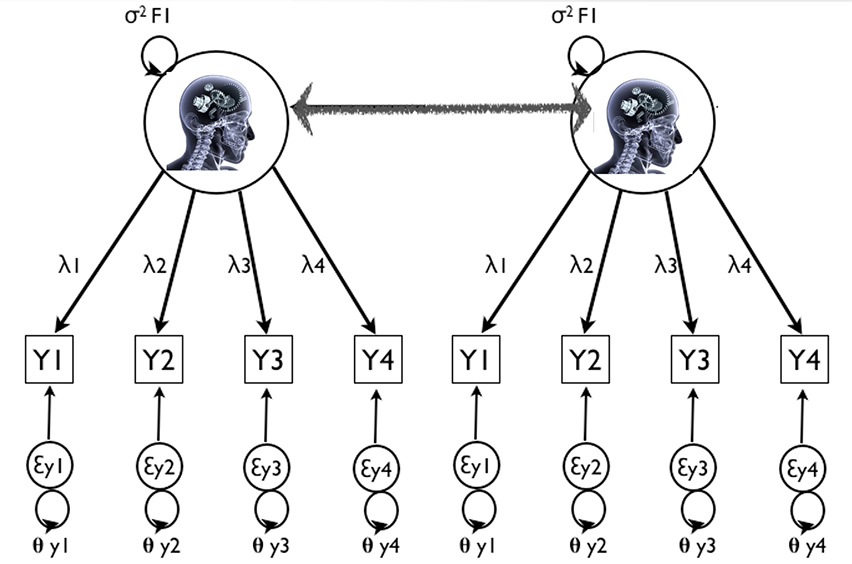
Multi-item surveys are frequently used to study scores on latent factors, like human values, attitudes, and behavior. Such studies often include a comparison, between specific groups of individuals or residents of different countries, either at one or multiple points in...

How to handle missing data: A comparison of different approaches
Many researchers face the problem of missing data in longitudinal research. Especially, high risk samples are characterized by missing data which can complicate analyses and the interpretation of results.
Collinear Latent Variables in Multilevel Confirmatory Factor Analysis: A Comparison of Maximum Likelihood and Bayesian Estimation
Because variables may be correlated in the social and behavioral sciences, multicollinearity might be problematic. This study investigates the effect of collinearity manipulated in within and between levels of a two-level confirmatory factor analysis by Monte Carlo simulation.


Prestigious VIDI Grant Awarded
I am awarded the prestigious VIDI-grant from the Netherlands organization for scientific research to start my own research group 🙂 1b. Title of research proposal: Experts, their prior knowledge, and the issue of limited data 1c.Summary of research proposal Researchers often...

Effectiveness, Mediators, and Effect Predictors of Internet Interventions for Chronic Cancer-Related Fatigue
This paper describes the design and analysis plan that will be used to study 2 Internet interventions aimed at reducing severe fatigue in cancer survivors: a mobile ambulant activity feedback therapy supported through a weekly email by a physiotherapist and...

Individual and class room predictors of same-cultural friendship preferences in multicultural schools
This study was an investigation of individual and contextual predictors for same-cultural friendship preferences among non-immigrant (n = 125), Turkish (n = 196) and former Yugoslavian (n = 256) immigrant youths (Mage= 14.39 years) in 36 multicultural classes.

Research Talent Grant awarded to Kimberley Lek
Our Research Talent proposal titled “How to hedge our bets in educational testing: combining test results with teacher expertise” has been granted by the Netherlands Organisation for Scientific research. Kimberley Lek will work on this project for the next 4 years. Summary...

Analyzing small data sets using Bayesian estimation: the case of posttraumatic stress symptoms following mechanical ventilation in burn survivors
The analysis of small data sets in longitudinal studies can lead to power issues and often suffers from biased parameter values. These issues can be solved by using Bayesian estimation in conjunction with informative prior distributions.
Latent trajectory studies: the basics, how to interpret the results, and what to report
In statistics, tools have been developed to estimate individual change over time. Also, the existence of latent trajectories, where individuals are captured by trajectories that are unobserved (latent), can be evaluated (Muthén & Muthén, 2000).

Latent Growth Mixture Models to estimate PTSD trajectories
Statistical models to estimate individual change over time and to investigate the existence of latent trajectories, where individuals belong to trajectories that are unobserved (latent), are becoming ever more popular.
Using Bayesian statistics for modeling PTSD through Latent Growth Mixture Modeling: implementation and discussion
After traumatic events, such as disaster, war trauma, and injuries including burns (which is the focus here), the risk to develop posttraumatic stress disorder (PTSD) is approximately 10% (Breslau & Davis, 1992). Latent Growth Mixture Modeling can be used to...

Social Influence Interpretation of Interpersonal Processes and Team Performance Over Time Using Bayesian Model Selection
The team behavior literature is ambiguous about the relations between members’ interpersonal processes—task debate and task conflict—and team performance. From a social influence perspective, we show why members’ interpersonal processes determine team performance over time in small groups.